
Cost guide
What Does Septic Pumping Cost in NH?
There's no single honest number for a septic pump-out, and anyone who gives you one sight unseen is guessing. Here's what actually moves the price, what you're paying for, and how to spend less over the life of your system.
Free estimates. Straight answers over the phone.
(603) 554-7276Current published rates
Nate's live septic pumping rates by tank size, as of July 2026.
- 1,000 Gallon Tank$330
- 1,250 Gallon Tank$380
- 1,500 Gallon Tank$430
- 2,000 Gallon Tank$530
Why there's no flat rate
What drives the price of a septic job
Two houses on the same road can be genuinely different jobs. These are the things that make the difference — and most of them are knowable before anyone shows up.
Tank size
A tank's capacity sets the floor on the work: a larger tank holds more volume to pump out, takes longer to empty, and puts more material in the truck to haul and dispose of. Residential tanks in this area vary quite a bit in size, and that alone can separate two otherwise identical jobs.
How easy the tank is to reach
If the lid is at grade under a riser, the tank is open in under a minute. If the lid is buried under six inches to several feet of soil, sod, a garden, or a deck, someone has to find it and dig it out before pumping even starts — and then backfill afterward. Access for the truck matters too: a long, soft, or steep driveway means more hose and more setup.
How risers fix buried lidsHow long since the last pump-out
A tank on a regular schedule pumps out cleanly. A tank that hasn't been touched in a decade has a hardened sludge layer and a heavy scum mat that take longer to break up and remove properly. The work is the same idea, but it isn't the same amount of time.
What a pump-out involvesDistance and location
Travel to the property and the haul to a licensed disposal site are both real costs built into any septic job. A property farther out, or one that's hard to get a loaded truck in and out of, carries more of that than a house a few minutes down the road.
Condition of the system
A routine, healthy tank is a predictable visit. A tank that's overfull because the outlet side is blocked, a system that's actively backing up into the house, or heavy solids carried out toward the leach field all mean diagnosis on top of pumping — figuring out what went wrong, not just emptying the tank.
Backing up right now?Whether extra work turns up
With the tank empty, problems become visible: a cracked or missing baffle, a damaged lid, a settled or clogged distribution box, an effluent filter that needs cleaning. None of that is guessable from the driveway, which is exactly why an honest quote for pumping is a quote for pumping — with anything found discussed before it's done.
Distribution box serviceWhat you're paying for
Inside a professional pump-out
1. Locating and opening the tank
The tank and its access lids are located and opened. With a riser that's lifting a cover; without one it means digging down to the lid first. If nobody knows where the tank is, finding it is part of the visit.
2. Reading the tank before anything comes out
Sludge depth on the bottom, scum thickness on top, and where the liquid level sits relative to the outlet all say something. A tank sitting above its normal level points at the outlet side rather than the tank itself.
3. Pumping liquid, sludge and scum
All three layers come out, not just the easy liquid off the top. Skimming the liquid makes a tank look empty while leaving the settled solids that caused the problem — this is the difference between pumping a tank and actually cleaning it.
4. Inspecting the empty tank
With the tank down, inlet and outlet baffles or tees, the concrete, and the lid are all visible. Anything wrong gets pointed out while the tank is open, when looking at it costs nothing extra.
5. Closing up and hauling away
Lids are reseated, any dug access is backfilled, and the waste is hauled to a licensed disposal site. Disposal is a real, per-load cost — it's part of what a pump-out price covers.
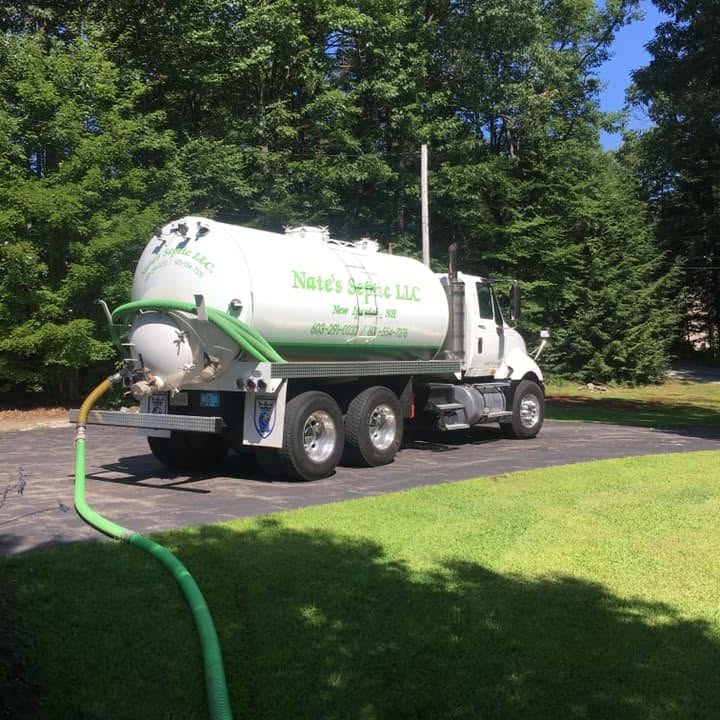
Spend less over time
How homeowners keep septic costs down
Pump on schedule instead of after a backup
Routine pumping is planned, quick and predictable. A backup is an unplanned call, usually with cleanup, sometimes with a blocked line to clear, and occasionally with damage further out in the system. The same tank costs less to maintain than to rescue.
Routine pumpingInstall risers
A riser brings the tank opening up to ground level with a sealed, secure lid. It's a one-time job that removes the digging from every future pump-out and inspection for as long as you own the house.
Riser installationKnow where your tank is
Keep a note, a sketch, or a photo of the lid location and any as-built plan for the property. Not spending part of a service visit hunting for a buried lid is free money back in your pocket.
Spread out your water use
Running six loads of laundry in one afternoon pushes a surge of water through the tank, which stirs solids and carries them toward the leach field instead of letting them settle. Spreading heavy use across the week is one of the cheapest things you can do for a septic system.
Be careful what goes down the drain
Wipes labeled flushable, paper towels, grease, and harsh chemicals all cause problems a tank was never designed to handle. Keeping them out is the difference between a tank that pumps cleanly and one that needs extra work.
How pricing works at Nate's Septic
No games, no guessing
Free project estimates
There's no charge to get a number on your project.
Straight answers by phone
Call (603) 554-7276 and talk it through — tank size, access, and last pump-out get you a real answer.
Credit cards accepted
Card payment is accepted for work completed.
This guide deliberately doesn't quote figures, because the number that matters is the one for your tank on your property. Current published rates, when they're posted, live on the pricing page — that page is kept up to date and is the source of truth for prices, not this article.
FAQ
Cost questions
Why do quotes differ so much between two houses?
Because the two jobs aren't the same job. Tank size, whether the lid is at grade or buried, how long it's been since the last pump-out, how far the truck has to travel, and the condition of the system all change how much time and how much material are involved. Two houses on the same street can be genuinely different work.
Is a backup more expensive than routine pumping?
Generally, yes — and usually not because pumping suddenly costs more. A backup adds diagnosis, often adds clearing a blocked line, and sometimes reveals a component that needs repair. Routine pumping is one predictable task; a backup is that task plus figuring out what went wrong.
Can I get a firm price over the phone?
You can get a straight answer about how pricing works and what would change it. A firm number depends on things worth confirming first — tank size, whether the lids are accessible, and roughly when it was last pumped. Call (603) 554-7276 and you'll get an honest picture rather than a number that changes when the truck arrives.
Does the price go up if you can't find the tank?
Locating and digging out a buried lid is real work that a job with a riser doesn't involve, so it's part of what a quote reflects. The good news is it's a one-time problem: adding a riser during that visit means the digging never has to happen again.
What if you find something broken while the tank is open?
You hear about it before anything is done. A cracked baffle, damaged lid, or failing distribution box gets shown and explained, along with what fixing it involves, so it's your decision rather than a surprise on the invoice.
Is the cheapest quote the best value?
Not necessarily. A very low price sometimes means the liquid is skimmed off the top and the solids are left behind — the tank looks empty, the invoice looks great, and you're pumping again far sooner than you should be. What matters is that the sludge and scum actually leave the tank and the components get looked at.
Do you charge for an estimate?
No. Nate's Septic offers free project estimates, and credit cards are accepted for payment.
More septic questions answered on the septic FAQ hub.
Free estimate
Tell us what's going on
Send the basics and we'll get back to you with a free estimate. In a hurry? Calling is always fastest.
(603) 554-7276Serving New Ipswich, NH and surrounding towns. Credit cards accepted.