Services in detail

What we actually do

Nate's Septic works in two related areas: pumping and excavation. Below is a plain-English walkthrough of each service — what happens on site, and why it matters for your system.

Pumping

Pumping & drains

The routine side of septic ownership: getting solids out of the tank on a sensible schedule, and clearing the line when waste stops moving the way it should.

Septic tank pumping & cleaning

What's involved

Locating and opening the tank, pumping out the liquid and the settled sludge and floating scum layers, and hauling it away to a licensed disposal site.

Why it matters

A septic tank works by letting solids settle while liquid moves on to the leach field. Those solids never leave on their own. Once the sludge layer gets deep enough, solids start carrying over into the field — and a clogged leach field is the expensive repair a pump-out exists to prevent.

Most household tanks are pumped every few years, depending on tank size and how many people live in the house. Yours may differ — we can talk through it.

Drain clog & blockage clearing

What's involved

Tracking down where flow has stopped between the house and the tank, and clearing the blockage so fixtures drain normally again.

Why it matters

Slow drains, gurgling toilets, or several fixtures backing up at once usually point past the individual fixture and toward the main line or the tank itself. Finding which of those it is comes first — clearing the wrong thing solves nothing.

Commercial pump-outs

What's involved

Scheduled pump-outs for businesses, rentals, and multi-unit properties, worked around your operating hours.

Why it matters

Commercial systems typically take heavier and less predictable loads than a single household, so they run through their capacity faster and benefit from being on a regular schedule rather than waiting for a problem.

Excavation

Excavation & repair

The digging side. When a component is buried, broken, or not doing its job, it has to be reached and fixed — and that takes equipment on site. We run our own John Deere 35 mini excavator.

Why a mini excavator matters on a septic job

Small machine, real digging

Septic components are rarely in a convenient open field. Tanks, D-boxes, and lines end up in narrow side yards, tucked between a house and a garage, behind a fence with a single gate, or set close to a foundation because that's where the layout allowed. A full-size excavator simply can't get to a lot of those spots — and when it can't, the work turns into hand digging or tearing out landscaping, a driveway, or fencing to make room.

A compact machine changes that math. It fits through gates and side yards, works on a normal residential lot without wrecking it, and still has the reach and breakout power to do actual excavation: getting down to a buried tank, opening up around a D-box, digging to a broken pipe, and backfilling when the repair is done. Small refers to the footprint, not to what it can dig.

Zero tail swing is the other half of it. On a conventional excavator, the back of the cab swings out past the tracks as the machine rotates, so anything within that arc — a wall, a deck, a fence, a parked car — has to be cleared or avoided. A zero-tail-swing design keeps the rear inside the track width, so the operator can spin and work right alongside a house or fence line without the counterweight hitting it.

For a homeowner, the practical result is a smaller hole, less disturbed lawn, and fewer things that have to be moved or taken apart before digging can start — on jobs where a bigger machine would either not fit or would cost you more in collateral damage than in digging.
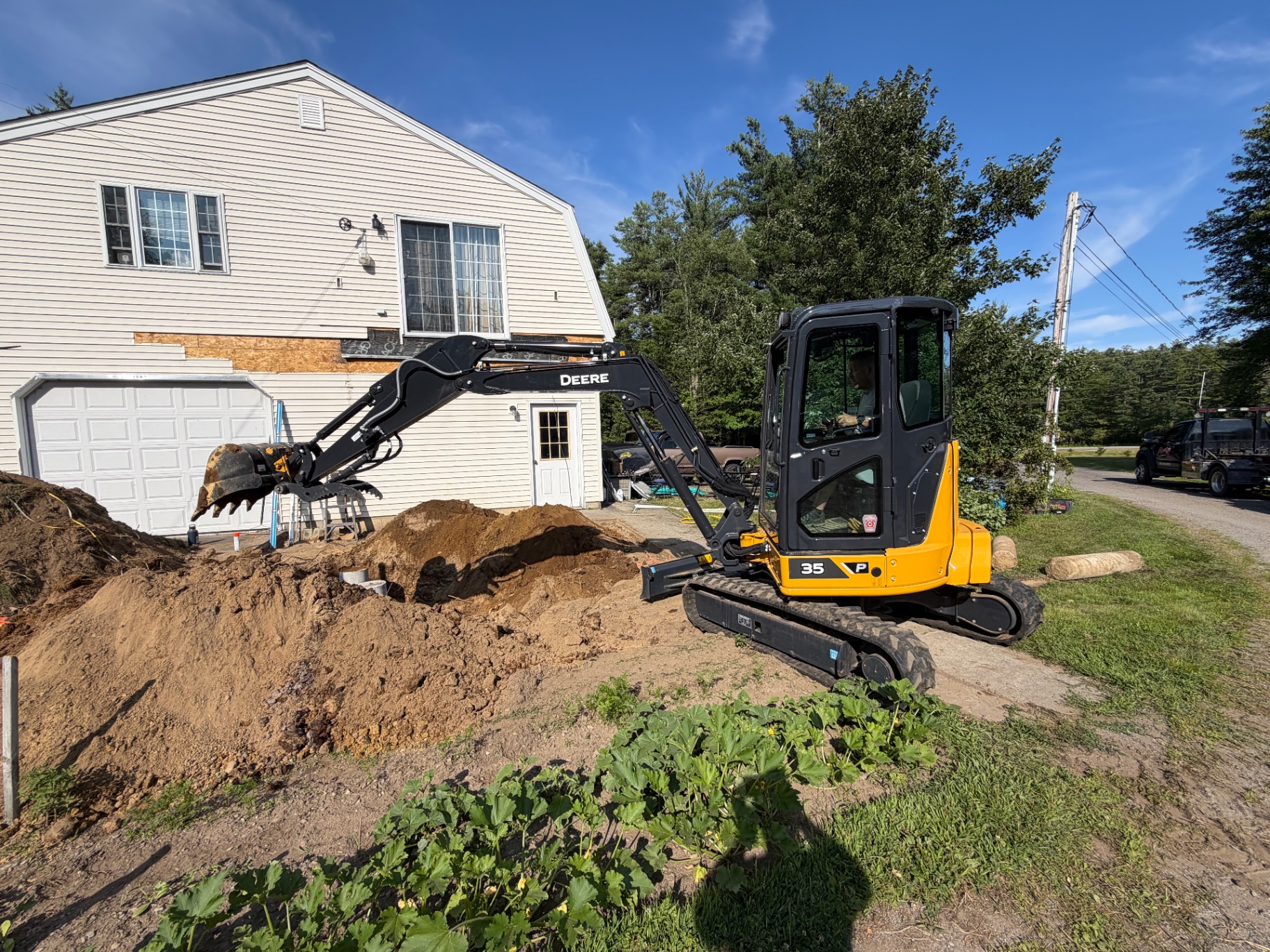
Nate's Septic John Deere 35 mini excavator working in a residential side yard beside a house and garage, with excavated soil piled next to an open septic hole
Our John Deere 35 mini excavator working tight to a house and garage on a residential septic dig.
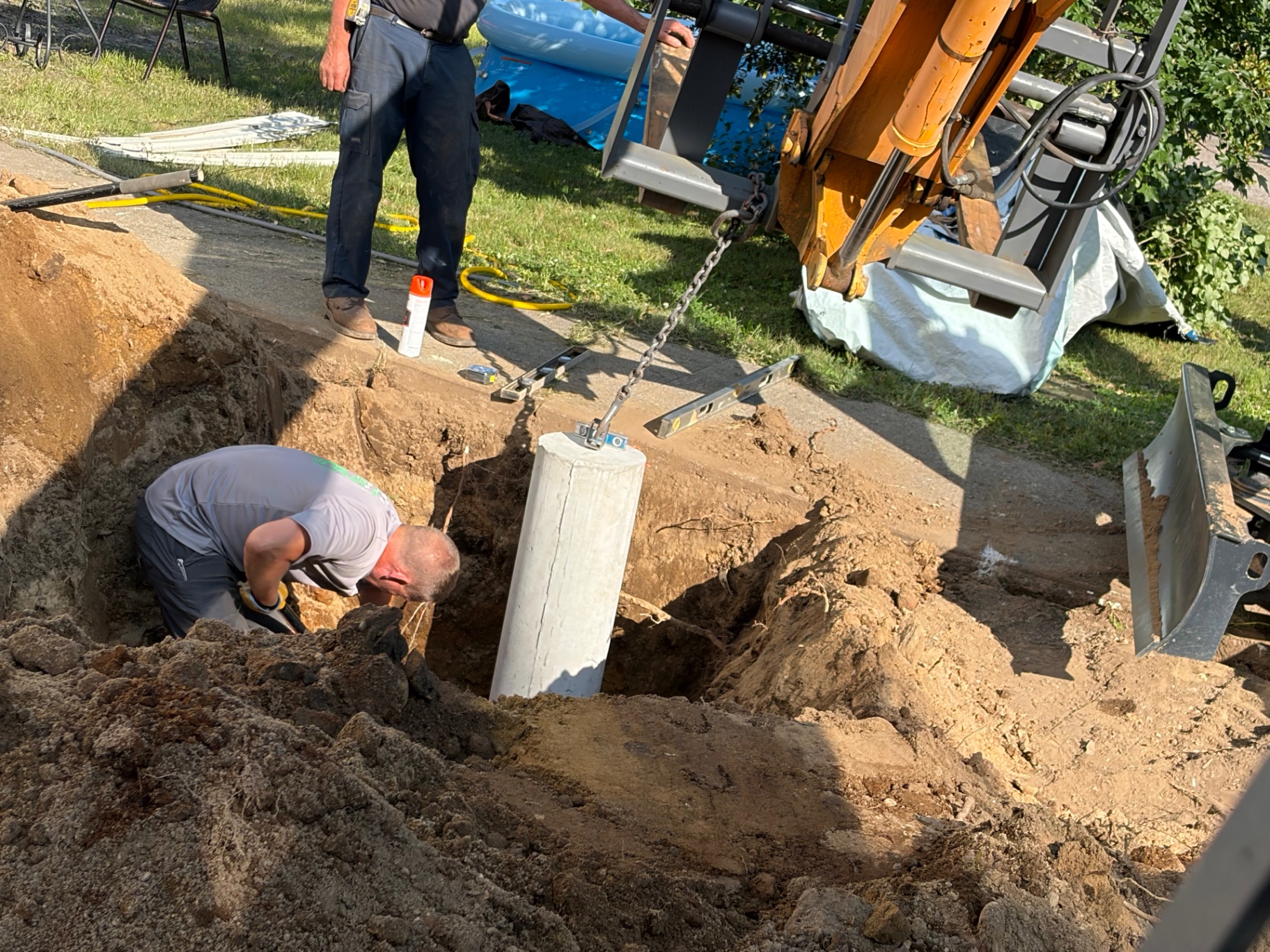
Crew setting a concrete septic riser into an excavated hole, lifted level by a chain from the mini excavator's bucket
Setting a concrete riser — lifted and leveled off the machine, then backfilled to grade.

Riser installation

What's involved

Installing a riser — a collar that extends the tank or D-box opening up to ground level — with a secure lid at the surface.

Why it matters

Plenty of tanks around here are buried a foot or more under the lawn. Without a riser, every pump-out and every inspection starts with digging. A riser turns that into lifting a lid, which saves time and keeps your yard intact.

Distribution box (D-box) service

What's involved

Uncovering the D-box, checking its condition and the level of its outlets, cleaning it out, and servicing or replacing what's failed.

Why it matters

The D-box sits between the tank and the leach field and splits the outgoing effluent evenly across the field's trenches. When it settles out of level, cracks, or fills with solids, all the flow can dump into one trench — overloading that section while the rest of the field sits unused. It's a small, cheap part that quietly protects a very expensive one.

Repairs

What's involved

Excavation-related septic repair work: damaged or collapsed lids, broken inlet and outlet pipes, baffles, and lines between components.

Why it matters

Septic components are concrete and plastic buried in wet ground, sometimes driven over. Lids crack, pipes shift and separate, and baffles deteriorate. Repairing the part that failed is generally a far smaller job than replacing what it damaged downstream.

Locating & uncovering buried components

What's involved

Finding the tank, lids, or D-box on properties where nobody knows where they are, and digging down to expose them for service.

Why it matters

Records get lost, houses change hands, and landscaping covers everything. Before any work can happen, the components have to be found. Once they're exposed, that's also the natural moment to add risers so it doesn't have to happen again.

Not sure which you need?

Describe what you're seeing and we'll tell you what it points to. Project estimates are free, and credit cards are accepted. Serving New Ipswich, NH and surrounding towns.

Call (603) 554-7276Free Estimate